
Summary
Production planning in machineries is shifting from manual work to intelligent planning supported by APS systems. The transformation is not just about implementing a system but about building a comprehensive capability where people, processes and real-time data play the key role. This guide presents five steps executives can take to lead the transformation.
Production planning is undergoing a transformation – from reactive to proactive, from manual to AI-driven. This guide helps machinery industry executives navigate this change, avoid pitfalls, and take control of the transition towards more structured, efficient, flexible, and competitive production.
Introduction: How is intelligent production planning revolutionising production management in machineries?
Manufacturers typically achieve good delivery reliability, but at a high cost. Traditional production planning methods, based on standard lead times and estimates of production capacity and resources, are no longer sufficient in an increasingly competitive environment. A production plan must be able to quickly adapt to frequent disruptions in global supply chains. At the same time, customers expect faster service. Additionally, cost pressures and sustainability goals pose their own challenges. Managing this complexity would be difficult even in simple production environments, but the machinery industry faces a higher number of variables due to multiple products, complex and multi-step production, and difficult-to-predict demand. The workload of manual production planning is simply too heavy to achieve the necessary responsiveness.
Delivery reliability comes with high opportunity costs. Inventories are oversized to ensure material availability, large machinery fleets compensate for weak capacity forecasting, temporary labour and overtime are used to increase workforce flexibility, and lead times are extended or penalties are paid for late deliveries.
Intelligent tools are transforming production management in machineries
|
This guide provides business and production executives in the machinery industry with tools to adopt a new intelligent approach to production planning. We will cover the impact of Advanced Planning and Scheduling (APS) on various roles and how leadership can support the successful implementation of this change. We will explore how manufacturers can build comprehensive capabilities to manage production and enhance efficiency to strengthen competitiveness.
The transformation of production planning
The transformation of production planning means shifting from traditional and manual methods to smarter, more automated solutions. Intelligent production planning tools, such as APS systems, help companies respond more quickly to changes, improve delivery reliability, and reduce costs.
Implementing APS brings significant changes to production planning and the entire organisation. It automates routine tasks, improves information flow, and provides real-time visibility into production. However, successful implementation requires careful planning and leadership, as people remain essential in maintaining data accuracy.
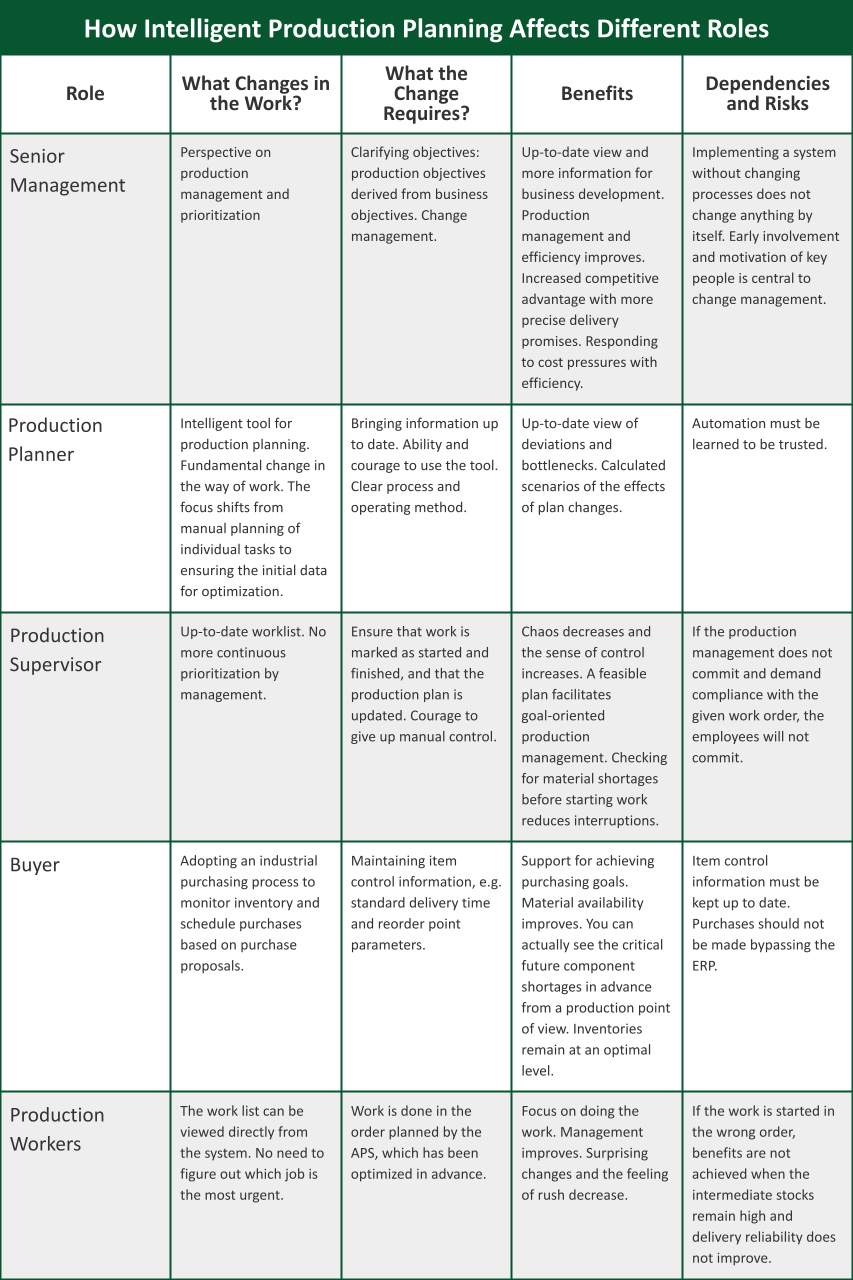
Change management
As outlined above, intelligent production planning is not just about implementing a new system but about building a comprehensive capability. Since we are changing how production is managed and planned, the adoption of new processes must consider both people and workflows. As a leader, you should reflect on the following:
- What are our most critical objectives for production?
- What is the priority between these objectives? Should we prioritise delivery reliability over tied-up capital, or efficiency over flexibility?
- How do we motivate people for this transformation?
- How do we ensure compliance with new operating methods?
- How should processes be modified to function in the era of automated planning?
Successful transformation is impossible without a solid foundation. Even the most advanced production planning cannot generate reliable forecasts or scenarios if the data is inaccurate. Additionally, production objectives must evolve. Today, merely focusing on cost efficiency is not enough. Since goals drive actions, it is crucial to define a compelling destination that will engage the workforce in this transformation journey.
Five steps to building capability
- Motivate and involve people
Early involvement of people is one of the best practices in any process or system development. It is the most effective way to ensure engagement in the transformation and reduces potential resistance. It also enhances the quality of the final outcome.
In production planning, too, every role in the order-to-delivery chain affects how well the cooperation between people and machines works. For example, if a buyer makes purchases outside the ERP in Excel, or an assembler does not log their work, production planning is not based on actual capacity and stock levels, and the benefits of intelligent production planning are lost. - Define a clear goal
Clarity in objectives is essential, as decision-making and prioritisation during the transformation will impact the outcome. For example, a goal of production efficiency steers the focus to modelling capacity as accurately as possible and the related processes. The priorities would look very different if the focus were on minimising inventory or on production flexibility. It is important to recognise whether the operating environment is about high volumes and standard products, or whether it is better described by a large number of product variants and a high availability target. - Ensure proper setup and maintenance
APS relies on data to model and optimise planning. Machineries typically have sufficiently accurate averages for lead times and workloads, so setting up the master data does not take long. When APS is implemented, it will quickly highlight any inaccuracies in these estimates. The key is not just initial data accuracy but ensuring ongoing maintenance of data quality. - Lead learning
A successful transformation is primarily a leadership issue. Adopting a new work method where, for example, production tasks must be logged and where each item must have an up-to-date availability and lead time requires discipline.
That is why we return to the importance of involving people early and defining a compelling goal. We must be able to explain why things are done in a new way and communicate our successes. Successes fuel the motivation to keep following the new process and operating model. - Establish and standardise the planning process
The new production planning approach takes shape in the first few months of APS implementation. Successes and challenges will reveal how to structure planning to achieve the best results. Manufacturers with multiple sites typically benefit from harmonising production planning and sharing best practices.
The outcome is a well-defined process that describes how planning is done and how related matters, such as stock levels, are managed. Efficiency improves as redundant work is eliminated. The business also benefits from consistent reporting, a clearer overall picture, and scalable operations.
Frequently asked questions
What does intelligent production planning mean?
It means shifting from manual methods to automated solutions, such as APS systems. The system calculates, predicts and indicates the risks of the plan, such as material shortages or capacity issues, while people focus on fine-tuning the plan.
What is APS?
APS (Advanced Planning and Scheduling) is a production planning system that automates routine tasks, improves information flow, and provides real-time visibility into production.
Why is manual production planning not enough in machineries?
The machinery industry faces many variables: multiple products, multi-step production, and difficult-to-predict demand. The workload of manual planning is too heavy, and delivery reliability comes at the cost of oversized inventories, overtime and longer lead times.
What are the five steps to building intelligent production planning capability?
Motivate and involve people, define a clear goal, ensure proper setup and maintenance, lead learning, and establish and standardise the planning process.
What is the role of leadership in the transformation?
Leadership defines the production objectives and their priorities, motivates people for the transformation, ensures compliance with new operating methods, and modifies processes to fit automated planning.
How do we help?
Pinja’s tools and processes help machinery industry executives succeed in the transformation towards smarter production planning. Our approach helps define a clear and measurable goal for the change, identifies the most critical areas for improvement, and outlines the steps to achieve them.
We help executives solve questions such as:
- What are the main factors causing production inefficiencies? Are we optimising capacity utilisation, focusing on reducing overtime, or eliminating material shortages?
- How can we reduce capital tied up in inventory? Is the priority to improve production accuracy, reduce component stock levels, or refine subcontractor management?
- Is the goal to improve delivery reliability, or to maintain the same high reliability but at a lower cost?
- Are lost sales a key challenge for competitiveness, and can we address this by providing more accurate and faster delivery estimates or by freeing up production capacity?
- What are the most important organisational goals in this transformation? For example, better management of change, time savings, improved communication, or enhanced job satisfaction.
Our experts have guided numerous manufacturers through the transition to smarter production planning. Our mission is to help leadership navigate the change and prioritise the actions that support the desired transformation. The goal should not be just to implement new technology, but to achieve the strategic objectives that drive competitive advantage.
Do you want to find out how you could benefit from intelligent production planning?