
Summary
The Waste Act has required a transfer document for transporting certain types of waste since 2012, and since the beginning of 2022, transfer documents have, as a rule, had to be electronic. The data is reported to the SIIRTO register maintained by the Finnish Environment Institute, which has been in use since 1 September 2022. An electronic transfer document service transfers the data to the register automatically, whereas the data from paper documents has to be entered manually.
In 2021, a new Waste Act came into force in Finland, and the topic has been subject to much debate, both in public and at coffee tables. The new obligations brought changes to the day-to-day work of the industry, and there are other reforms on the way, too.
Practices have become established, but questions still arise even among professionals. What is required of operators in the supply chain of waste-derived materials?
The act has required the use of transfer documents since 2012, and the obligation to switch to electronic transfer documents came into force at the beginning of 2022. The purpose of the transfer document is to collect more comprehensive and accurate information on waste for monitoring, control and statistics, and to improve the monitoring of hazardous waste in particular. The electronic transfer document beats its paper counterpart, for example in terms of ease of use, traceability and archivability in electronic format.
A transfer document is required when transporting:
- hazardous waste
- construction and demolition waste (excluding uncontaminated soil)
- contaminated soil
- sludge from septic tanks and cesspools
- sludge from sand and grease traps
- POP waste
Paper or electronic transfer document?
Electronic transfer documents are now the main rule. Paper transfer documents may only be used in exceptional cases, for example when waste is generated only a few times a year.
The data of transfer documents is recorded in SIIRTO, the register of waste transfer documents. Information on the above-mentioned movements of waste requiring a transfer document is recorded in the official register from the transfer documents of each operator. SIIRTO is maintained by the Finnish Environment Institute (Syke), and the register has been in use since 1 September 2022.
Data from an electronic transfer document service is transferred to the register automatically through an interface. If a transfer document is made on paper in an exceptional case, its data has to be entered in the register manually within three months of the end of the transport.
Two ways to report transfer documents to the authorities
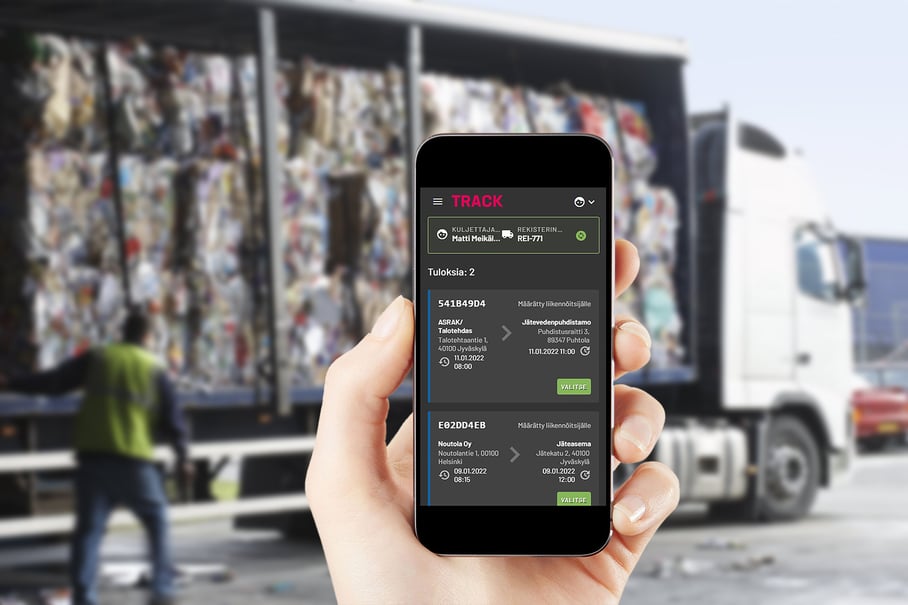
Pinja’s electronic transfer document service is browser-based and available on a variety of devices, from mobile phones to laptops.
There are two ways to report information on transfer documents to the electronic register of the authorities:
- Manually, i.e., by manual entry if a paper transfer document is used
- Automatically, if an electronic transfer document service is connected to the register
Manual entries are laborious and prone to human error. The number of waste transport and reception transactions can be up to thousands per week. As manually entering a single transfer document takes several minutes, entering thousands of them can easily take dozens of working hours a week – time away from more meaningful and productive work.
Relying on paper is prone to all kinds of human error and disorder. Paper transfer documents are passed from one person to another. They can get lost or end up in an archive until the reporting deadline looms and you have to put in a lot of effort to find them.
Pinja’s electronic transfer document service is an advanced solution for the reporting needs of the circular economy sector
Pinja’s electronic transfer document is a versatile application developed to meet the growing needs of the circular economy sector to share and report information in a transparent way between transport parties, in addition to meeting new regulatory obligations. The software is built to be simple and easy to use on the road or in the office. It is an electronic transfer document service that meets the needs of both individual drivers and large operators.
The flexibility of the system is well demonstrated by the very different use cases of our clients. In its simplest form, drivers can create transfer documents on the road using their mobile device. In the most versatile case, transfer documents are created based on orders from the client’s ERP system, providing the receiving facility with advance information on incoming loads. In addition to the transfer document, the transport completion data can also be automatically updated in the client’s own system.
Clear and straightforward sharing of transport data and reporting to each party involved in the transport is already possible in the basic functionalities of the software. This means that no time is spent on sending documents or reporting to the customer, as the parties involved are given access to the information that concerns them. Our clients use this information for purposes such as billing, site reporting and the annual regulatory report for the environmental permit. Integrations also allow for more versatile use of data, for example through BI tools.
Pinja offers a simple and quick-to-use electronic transfer document service, built together with the industry and designed to meet even the smallest needs. As your needs grow, the software can be scaled to meet even the most demanding requirements.
Want to know more? In our guide Electronic transfer document as a tool for transport management and digitalisation, we explain the possibilities and benefits of electronic transfer documents in more detail and open up the implications of the Waste Act for the processing of transfer documents.
Frequently asked questions
What is a transfer document?
A transfer document is a document required by the Waste Act that accompanies waste from the waste holder to the transporter and the receiver. It records information such as the type, quantity, origin and destination of the waste.
Which types of waste require a transfer document?
A transfer document is required when transporting hazardous waste, construction and demolition waste, contaminated soil, sludge from septic tanks and cesspools, sludge from sand and grease traps, and POP waste.
What is the SIIRTO register?
SIIRTO is the register of waste transfer documents maintained by the Finnish Environment Institute. Transfer document data has been reported to the register since 1 September 2022, and data from an electronic transfer document service is transferred to it automatically.
Can paper transfer documents still be used?
Only in exceptional cases, for example when waste is generated rarely. The data of a paper transfer document has to be entered in the SIIRTO register manually within three months of the end of the transport.
Read more
Electronic Transfer Document Service – transfer documents and SIIRTO reporting in one service
Material Flow – material flow management
Bioenergy & Recycling – solutions for the circular economy sector