MES
Manufacturing Execution System
An MES improves productivity and increases competitiveness
A Manufacturing Execution System (MES) collects production data in a single system and provides an efficient, real-time tool for production control, management and day-to-day operations.
Find out more: MES
What | Why | For whom | How | Pinja’s MES solution | Contact us
What is an MES?
An MES (Manufacturing Execution System) is a tool for production management and development. It brings together the information flows about orders, products, materials and processes needed to manage the internal production chain. The system brings together the company’s entire manufacturing operations, providing a transparent and visual view of production progress. It ensures that all manufacturing work is completed and reported on time and according to plan.
Company objectives define the scope of the MES solution
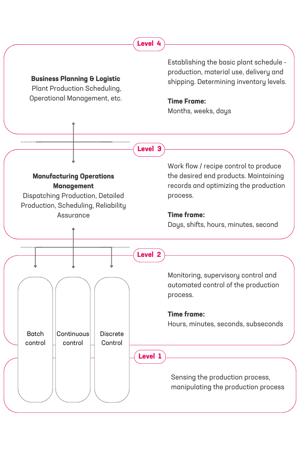
According to the standard, Manufacturing Operations Management (MOM) activities include those activities in the manufacturing environment that coordinate personnel, equipment, materials and energy when raw materials are used to make parts and products. MOM functions generally cover production planning, scheduling, data collection and reporting.
The demarcation and division of tasks between an MES and other systems used in production is not always clear. Therefore, the term MES is often used inconsistently for systems that include any MOM functions.
The standards roughly define the scope of MES, but there are many interpretations of what functionalities are included. When considering a system acquisition, it is essential to remember that an MES is always a solution that serves the needs of production, and the needs and expectations for the system vary greatly depending on the nature of the operations, the industry or the objectives. It is important to identify the company’s needs and challenges in production and try to solve them in the best possible way.


Is MES the same as ERP?
MES and ERP systems are both an integral part of a manufacturing company’s system landscape. Enterprise resource planning (ERP) helps organisations manage and automate key business processes. An MES, on the other hand, focuses mainly on managing and controlling production processes in the manufacturing industry. However, there is also a lot of overlap between the functions of the two systems.
At their best, ERP and MES create an integrated ecosystem that provides a holistic view of a company’s operations, including sourcing, supply chain management, manufacturing logistics and more. Understanding the roles and interplay of MES and ERP systems helps you understand their characteristics, essential differences and objectives.
Why should a company acquire an MES?
Increasing productivity, reducing lead times, improving quality and enhancing internal delivery reliability are common reasons for acquiring an MES. Timely and reliable information is essential for the smooth execution of work and effective management. For the manufacturing industry, an MES is critical because it enables the collection, analysis and reporting of real-time production data. This helps manufacturers better monitor and manage production processes.
In addition to providing a basis for production management and development, an efficient MES also supports operators in their daily work. When both management and operators can see how the shift has gone and what to do next, it helps them develop mutual interaction.
The benefits that an MES helps you achieve:
Pinja’s MES is a scalable and modular solution
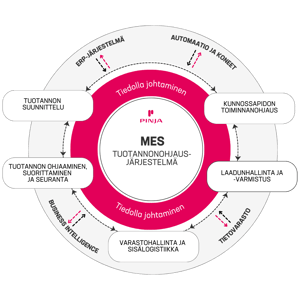
The information needed in production is usually obtained from various systems, machines, equipment, factory automation and production workers. Several different systems may be used in production, such as PDM, SCM and APS. All of these often interface with the company’s enterprise resource planning (ERP) system. In addition, data collection systems are needed to gather information directly from machines and equipment and from the operators who use them.
To make production as smooth as possible, all systems should be simple and intuitive to use. Pinja’s MES solution makes overall management easier by bringing together production control and the information needed for production in one system. It is part of the Production Operations suite, in which MES and APS work together.
Who is an MES for?
An MES provides a tool for unifying scattered digital information and helps ensure that employees have access to all the information they need. An MES is suitable for all manufacturing companies, but it is especially effective in solving challenges in companies where production data is scattered and difficult to manage.
Our satisfied MES customers:


How should you go about acquiring an MES solution?
The idea behind acquiring an MES may be, for example, the need to increase productivity, reduce lead times, improve quality and enhance internal delivery reliability. In addition, there is often a need to make production workers’ jobs easier and to digitalise scattered, manually collected data.
Before acquiring a system, it is important to review the current situation as thoroughly as possible, and in particular what you are trying to change. In addition to the data, it is also a good idea to review the current processes and whether the current systems support production in the best possible way. Often, the aim of a system acquisition is to change a process, so one of the purposes of the project is to introduce new ways of working into everyday operations through the system.
Wondering what kind of MES solution would suit your production? Our experts can help you assess your current situation and define your goals. Book an appointment with an expert