
Skip to content
Supply Chain

Timber procurement & logistics
Log receiving & inventory
Material flow tracking
End-to-end fuel supply chain management
Production & Processing

Sawmill operations & wood processing
Manufacturing planning and operation
Maintenance management system
Production monitoring
Sales & Delivery

Demand forecasting & planning
E-commerce solutions
All-in-one cloud ERP
Digital Platform

IT & development
Business intelligence & data analytics
A Coniferous Forest Viewed from Above - EUDR: Key Requirements and Impacts

What is the EUDR? A breakdown of its main requirements and impact

Summary

The EU Deforestation Regulation (EUDR) requires that timber, soy, coffee and other regulated commodities placed on the EU market are deforestation-free and legally produced in their country of origin. Companies must collect information on the origin of their products, assess and mitigate risks, and be able to demonstrate that their supply chains are traceable. For large and medium-sized companies, the obligations apply from 30 December 2026.


The European Union Deforestation Regulation (EUDR) is a game-changing policy aimed at tackling global deforestation linked to supply chains. For businesses, it introduces strict compliance requirements that affect how goods are sourced and traded, with serious penalties for non-compliance.

The stakes are high – between 2019 and 2021, the EU was exposed to an average of 190,500 hectares of deforestation annually from its direct imports. The urgency to comply is further highlighted by the fact that only 20% of companies assessed across relevant industries currently have a strong or very strong deforestation programme in place to meet EUDR requirements.

This article breaks down what the EUDR is, its main requirements and its broader implications.

Glowing green EUDR button in a dense forest – EU Deforestation Regulation requirements for companies

Breaking down the EUDR rules and what they mean

The European Union Deforestation Regulation (EUDR) introduces a significant shift in how certain industries operate, with the goal of curbing global deforestation and ensuring the legality of products entering the EU market.

The regulation applies to any company involved in the import, export or sale of regulated products within the EU market, regardless of whether the business is registered in the EU or based in a third country. This makes compliance mandatory for industries such as forestry, wood processing and agricultural supply chains, which must adapt their practices to meet the regulation’s stringent requirements.

Businesses trading in regulated commodities, such as soy, coffee, wood or palm oil, must also ensure their supply chains are deforestation-free and fully traceable to avoid penalties, including fines of up to 4% of turnover or confiscation of non-compliant products.

The EUDR places particular pressure on agricultural supply chains, as products like coffee, cocoa and rubber are often sourced from regions vulnerable to deforestation. Similarly, the wood processing industry faces challenges in certifying that timber and related products meet the regulation’s strict criteria.

Companies across these industries will need to implement systemic changes, often requiring significant investments of time and resources.

The EUDR compels businesses to prioritise transparency, traceability and legal compliance across their supply chains.

1. Deforestation-free and legal compliance

Understanding the EUDR’s requirements for deforestation-free and legal compliance is important for businesses looking to access the European Union market. These two pillars directly address the regulation’s overarching goal: ensuring that commodities and products linked to deforestation and illegal practices are excluded from the EU supply chain. You can read about the latest changes to the regulation in our EUDR status update.

The deforestation-free criteria establish a clear benchmark. Products entering the EU must not originate from land that has been subject to deforestation or forest degradation after 31 December 2020. This means that agricultural commodities, timber and other goods must come from areas where the natural forest cover remains intact.

Green seedling rising from dark soil – EUDR deforestation-free and legality requirements

Forests, in this context, are defined as ecosystems with dense tree cover and other vegetation that have not been converted to other land uses, such as agriculture or urban development. By setting this fixed cut-off date, the EUDR aims to prevent further forest loss while holding producers accountable for their land-use practices.

Equally important are the legal compliance requirements for products. Commodities must adhere to the national laws of their country of origin, encompassing a broad range of legal frameworks. These include environmental regulations, land-use laws and labour standards.

For example, timber sourced from a particular region must not only meet sustainability standards but also comply with local forestry laws governing harvesting, transportation and trade.

Compliance with these laws ensures that products entering the EU market are not only sustainable but also ethically sourced and legally verified. This alignment with local regulations underscores the EUDR’s commitment to addressing both environmental and social impacts.

The EUDR enforces both deforestation-free sourcing and adherence to local legal frameworks for EU market access.

2. Due diligence process

The due diligence process ensures that businesses operating within the EU market are accountable for preventing deforestation and complying with legal requirements throughout their supply chains. This process is based on three key actions: information collection, risk assessment and risk mitigation.

The first step, information collection, requires operators to gather detailed and verifiable data about their supply chains. This includes precise geo-coordinates of production areas to confirm the origins of raw materials and assess their deforestation risks. Maintaining comprehensive records is important at this stage. These records serve as evidence of compliance and provide the foundation for the subsequent steps in due diligence.

Once the data is collected, a risk assessment must be conducted. This involves analysing the likelihood of deforestation or legal violations within the supply chain. Risk levels are determined by evaluating factors such as the geographic location of suppliers, regional deforestation trends and the practices employed by suppliers.

A supplier operating in a region with high deforestation rates might pose a greater risk than one in a region with strong environmental protections. By identifying these risks, companies can prioritise areas that require closer scrutiny.

The final step, risk mitigation, focuses on addressing identified risks to ensure compliance with EUDR requirements. Companies must take proactive measures to minimise these risks. Some common approaches include:

  • Requiring additional documentation from suppliers to verify their compliance.
  • Conducting more frequent audits of high-risk suppliers.
  • Partnering with third-party verification services to validate supply chain practices.
  • Sourcing materials exclusively from certified suppliers who adhere to deforestation-free standards.

These actions help businesses close compliance gaps and demonstrate their commitment to sustainable practices.

Accurate and detailed supply chain data forms the foundation of EUDR compliance.

3. Traceability and monitoring

Traceability and monitoring provide the mechanisms to verify that products are sourced responsibly and meet the regulation’s deforestation-free and legal requirements. This involves creating a robust system that tracks products throughout their supply chain and enables transparent reporting for regulatory oversight.

Supply chain traceability is critical for confirming that products meet EUDR standards. To comply, operators must ensure that products can be traced back to their source, such as the farm or forest where the raw materials originated.

However, the EUDR does allow some flexibility in cases where traceability for an individual item is impractical. For example, if an operator can demonstrate that an entire batch or mass of goods is 100% EUDR-compliant, direct traceability to every individual product might not be required.

This approach balances strict compliance with operational feasibility, particularly in industries with complex supply chains.

Data transparency complements traceability by ensuring that operators maintain clear and accessible records. Under the EUDR, businesses must document their sourcing practices and make these records available for regulatory review.

Standardised data reporting plays a key role here, as it enables authorities to efficiently monitor compliance across industries. Standardisation also benefits operators, as it simplifies reporting processes and reduces the risk of errors or misinterpretations.

Traceability and data transparency are the cornerstones of EUDR compliance.

4. Timelines and reporting

The EUDR sets specific compliance deadlines based on company size. Medium and large companies must meet all obligations from 30 December 2026. Micro and small enterprises, which often have fewer resources to adapt, have until 30 June 2027 to comply.

These deadlines emphasise the importance of early preparation. Companies that delay risk non-compliance, which could lead to penalties or disruptions in trade. Early planning allows businesses to adjust their supply chains, implement due diligence systems and address any unforeseen challenges before the deadline.

In addition to meeting these timelines, ongoing reporting obligations must be fulfilled. Under the EUDR, companies are required to submit regular compliance reports. Due diligence statements are submitted through the EU’s EUDR information system (formerly TRACES). The reports must detail supply chain information, including the origins of sourced commodities, and outline the due diligence measures taken to ensure compliance with deforestation-free and legal sourcing requirements. The reporting process is not a one-time activity.

Hourglass and wall calendar – EUDR deadlines and reporting obligations are approaching

It requires constant monitoring and updating to reflect any changes in supply chains or sourcing practices. You need to ensure that your data systems are robust enough to capture and document relevant information accurately.

To meet these requirements effectively, you should focus on:

  • Establishing centralised systems to collect and organise supply chain data.
  • Setting up regular internal audits to verify compliance with EUDR standards.
  • Training supply chain partners to align with required documentation practices.
  • Allocating resources to maintain ongoing monitoring and adapt to regulatory updates.

Pinja’s wood and forestry solutions provide end-to-end digital tools designed to meet these needs. With systems like Forestry Operations for wood procurement and logistics, Solid Wood Operations for sawmill operations and Terminal Operations for raw material management, Pinja ensures full traceability, operational efficiency and compliance with regulations like the EUDR.

Our customisable and scalable solutions streamline your processes while enabling you to align with sustainability goals and reduce compliance risks.

Preparing early and maintaining accurate reporting systems is important for EUDR compliance.

EUDR compliance made manageable: overcoming common challenges

Challenge 1: Ensuring supply chain traceability

Ensuring supply chain traceability is important for meeting the EUDR’s requirements. It enables companies to prove their products originate from deforestation-free and legally compliant sources. However, achieving this level of transparency across complex supply chains is a significant challenge.

One major obstacle is mapping the origins of raw materials, especially when supply chains involve multiple tiers of suppliers and intermediaries. Industries such as forestry and bioenergy face particular difficulties in linking raw materials to finished products and verifying that these materials meet EUDR standards.

To address this, digital traceability systems, such as Forestry Operations, are becoming critical tools. These systems allow companies to map and document their supply chains in real time, providing an accurate view of material flows.

Ensuring supply chain traceability under the EUDR

By tracking materials with geo-coordinates, businesses can ensure their sourcing aligns with deforestation-free zones. Such precision simplifies compliance by directly linking products to verified origins.

Data transparency across supply chains is another significant issue. Many companies encounter gaps in data availability or reliability because of inconsistent practices among suppliers.

This lack of standardisation complicates efforts to gather accurate and actionable information. Without a unified approach to data collection and sharing, identifying risks and ensuring compliance becomes far more difficult.

Real-time monitoring tools offer a solution to these transparency challenges. These tools enable continuous verification of supply chain data, reducing the likelihood of errors or omissions.

Additionally, encouraging suppliers to adopt standardised reporting frameworks can streamline the flow of accurate information. Standardisation ensures that data from different sources is comparable and reliable, which is critical for meeting EUDR requirements.

Digital tools and real-time monitoring are key to making supply chains traceable and compliant.

Challenge 2: Managing compliance costs

Managing compliance costs is a significant challenge for many businesses under the European Union Deforestation Regulation (EUDR). This is especially true for smallholders and small and medium-sized enterprises (SMEs), which often operate with limited financial and technical resources.

The costs associated with implementing traceability and monitoring systems, coupled with the resource-intensive nature of due diligence requirements, can strain these smaller operators disproportionately.

Smaller businesses face several financial pressures in meeting EUDR compliance:

  • Traceability and monitoring systems: These tools are important for tracking supply chain data but are often expensive to implement and maintain.
  • Limited resources: Smallholders might struggle to allocate funds for the necessary staff, training or technology to meet regulatory standards.
  • Compliance burdens: With fewer economies of scale, smaller operators often bear a higher per-unit cost of compliance than larger organisations.

Despite these challenges, solutions exist to mitigate financial strain and improve accessibility to compliance tools. Businesses can utilise EU- and industry-supported financial assistance programmes designed to help operators adapt to EUDR requirements. These programmes might provide grants, loans or subsidised services to reduce the initial costs of compliance.

Another major cost driver is the resource intensity of the due diligence process.

Additionally, technical support initiatives are available to guide businesses through the process of implementing affordable, scalable solutions tailored to their size and needs.

Another major cost driver is the resource intensity of the due diligence process. Gathering supply chain information, conducting risk assessments and maintaining accurate records require both time and expertise, which smaller organisations often lack.

In response, businesses can reduce manual effort by implementing automated systems that streamline data collection and evaluation. For example:

  • Automated interfaces: These tools connect directly with supply chain systems to retrieve real-time traceability data and ensure compliance records are accurate and up to date.
  • AI-driven tools: Artificial intelligence can help identify risks within the supply chain, assess compliance gaps and suggest mitigation measures, saving both time and labour.

By investing in automation, businesses can not only cut costs but also improve the efficiency and reliability of their compliance processes. Automating repetitive tasks, such as data entry and risk analysis, frees up resources that smaller operators can allocate to other critical areas.

Financial support programmes and automation tools can ease the compliance burden for smaller businesses.

Challenge 3: Navigating legal and regulatory variations

Manoeuvring through the legal and regulatory variations across different countries is a critical challenge for businesses seeking to comply with the EUDR. The complexity arises from the need to align the EUDR’s strict requirements with diverse local laws governing land rights, environmental protection and labour standards.

These discrepancies can create gaps in compliance and require businesses to adopt strategic approaches to ensure adherence.

One major difficulty is the patchwork of regulations that varies significantly from one country to another. For example, land ownership laws in some regions might conflict with environmental preservation rules, while local labour laws might fall short of international standards.
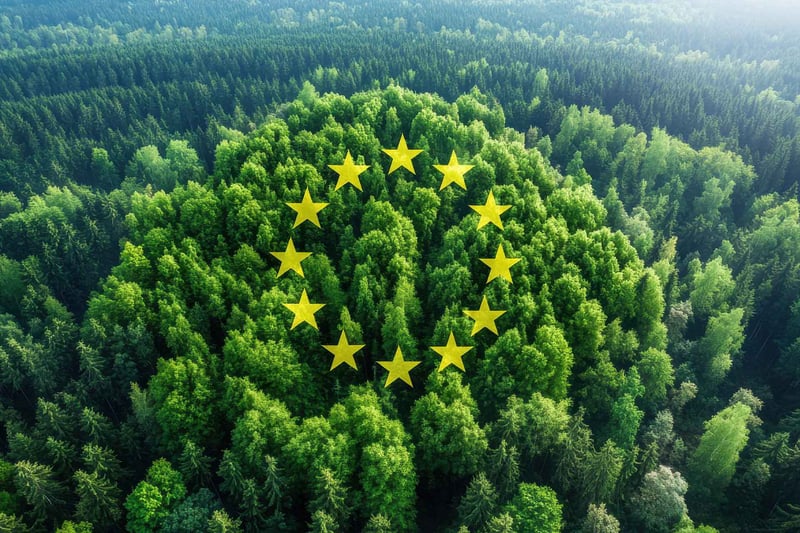
Coniferous forest from above with the EU flag’s ring of yellow stars – EU Deforestation Regulation (EUDR)

As a result, businesses are increasingly turning to regional legal experts and third-party auditors. These professionals have localised knowledge and can verify that operations align with both local and EU regulations. Collaborating with these experts ensures regulatory consistency while also providing the documentation needed to demonstrate compliance.

For instance, auditors can help validate land tenure records or confirm that suppliers are adhering to environmental laws, minimising the risk of legal disputes or penalties under the EUDR.

Another significant risk is incomplete or inconsistent documentation from suppliers. A lack of comprehensive records – such as land-use permits, labour compliance certifications or deforestation-free guarantees – can make it difficult to prove compliance during audits.

Standardising data collection practices can mitigate this issue. Implementing uniform processes across the supply chain ensures that suppliers provide all necessary documentation in a consistent format.

Digital tools can streamline this effort by centralising data, validating its accuracy and making it readily accessible for reporting. For example, supply chain management software offered by Pinja can integrate with local systems to collect and verify land-use data, creating a transparent and centralised repository for compliance purposes.

Aligning EUDR compliance with varied local laws demands both expertise and standardised processes.

Challenge 4: Overcoming technological barriers

Technological barriers are particularly pronounced for smaller operators, which often lack access to the advanced tools needed for effective traceability and reporting.

For these smaller operators, adopting scalable, user-friendly platforms is a viable solution. Cost-effective systems tailored to their specific needs can simplify compliance. Tools with intuitive interfaces reduce the time and effort required for training, making implementation faster and less burdensome. By prioritising accessibility and functionality, these platforms can help level the playing field for smaller businesses.

Coniferous forest from above with the EU flag’s ring of yellow stars – EU Deforestation Regulation (EUDR)

Larger organisations face a different set of challenges, particularly when integrating new technologies with existing legacy systems. Many businesses operate with outdated or incompatible systems, which can lead to data silos and inefficiencies. The lack of interoperability creates operational friction and can restrict the seamless flow of information necessary for compliance.

To address these integration challenges, adopt interoperable tools designed to work alongside existing systems. Gradual, phased implementation strategies allow companies to minimise disruptions while transitioning to more modern solutions. This reduces risks and ensures that operations remain stable throughout the upgrade process.

Scalable platforms and interoperable tools are important for overcoming technological barriers to EUDR compliance.

Challenge 5: Adapting to compliance deadlines

The EUDR’s phased deadlines – December 2026 for large and medium-sized companies and June 2027 for micro and small enterprises – provide a structured timeline for preparation. However, while the postponements offer additional time, relying on last-minute efforts can lead to rushed, inefficient processes and an increased risk of non-compliance.

To prepare effectively, businesses should develop a phased compliance strategy. This involves segmenting compliance efforts into manageable stages:

  • Prioritise high-risk suppliers and major products prone to deforestation-related concerns.
  • Establish clear timelines and milestones for each phase, ensuring progress is measurable and systematic.
  • Address lower-priority areas in subsequent phases, maintaining a balance between immediate needs and long-term goals.

Additionally, regular internal audits help ensure that potential compliance gaps are identified and resolved early. Maintaining transparent and consistent reporting practices can also help demonstrate adherence to EUDR standards to regulators and stakeholders.

These steps not only reduce the risk of penalties but also foster trust within supply chains.

Effective preparation for EUDR deadlines reduces compliance risks and operational disruptions.

Conclusion

The EUDR sets clear expectations for deforestation-free supply chains, tying legal compliance to environmental stewardship. It is both a regulatory mandate and a strategic opportunity for businesses to demonstrate accountability and future readiness.

By prioritising strict due diligence, robust traceability systems and proactive adaptation, organisations can meet these demands while strengthening operational resilience.

Pinja’s wood and forestry solutions are specifically designed to help businesses align with these best practices:

  • Forestry Operations centralises data collection and logistics management to ensure full supply chain traceability.
  • Terminal Operations streamlines raw material procurement and management, contributing to accurate inventory, waste reduction and real-time transparency across the supply chain.
  • Solid Wood Operations optimises sawmill production and material flow, helps manage compliance costs and improves operational efficiency.

Our scalable solutions empower your business to overcome technological and logistical barriers while maintaining a firm grip on EUDR requirements.

To explore how Pinja’s tailored solutions can help you meet EUDR requirements, book an appointment with our experts and take the next step towards sustainable and compliant forest industry management.

Frequently asked questions

What does the EUDR stand for?

The EUDR stands for the European Union Deforestation Regulation, a regulation aimed at reducing deforestation and forest degradation associated with commodities entering or leaving the EU market.

What are the requirements of the EUDR?

The EUDR requires products to be deforestation-free, legally compliant in their country of origin, fully traceable through supply chains and subject to due diligence, including data collection, risk assessments and regular monitoring.

Will the EUDR be delayed?

The EUDR has already been postponed twice. Medium and large companies must comply from 30 December 2026, while micro and small enterprises have until 30 June 2027.

What products are covered by the EUDR?

The EUDR applies to commodities such as cattle, cocoa, coffee, palm oil, soy, rubber and wood, as well as derived products like furniture, paper and leather goods.

Does the EUDR apply to packaging?

Yes, the EUDR applies to packaging if it is made from regulated commodities like wood, paper or other covered materials, requiring the same compliance measures as other products.